





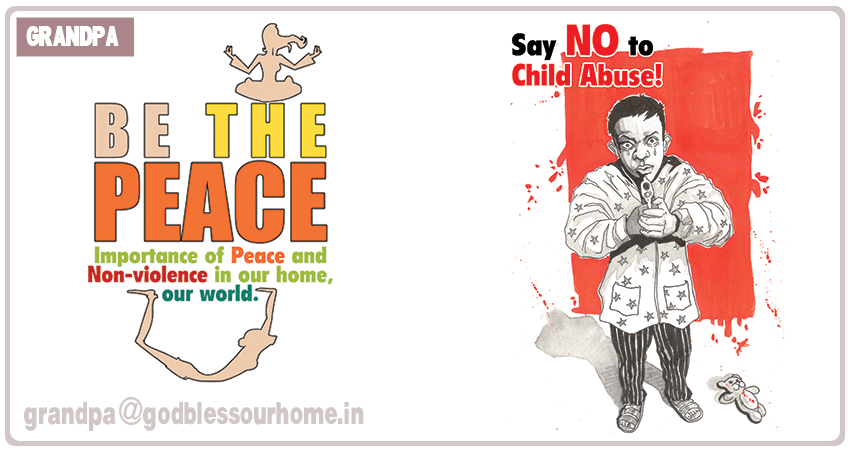
Looking back and reflecting on prosperity, I have observed that the greatest progress has been achieved in times of peace and social stability. Unless there is harmonious environment children cannot grow, adults cannot think or act properly and there is a constant air of stress/tension that inhibits any constructive thought or action. In an atmosphere full of violence, a family can never prosper, a country cannot progress. It is unfortunate that family institution is declining in the world. One of the reason is lack of tolerance and increasing violence in family. Violence could be breaking component to functioning of a family system. It may disrupt the entire flow of family system. The institution that forms the foundation of the society must be restored. A peaceful family is the base of a peaceful country. The father and mother represent peace and order, governing a family. If there is harmony between the two, it creates a supporting, loving environment where children flourish and mature into responsible adults. Peace nurtures progress and achievement. There is stability and a strong sense of belonging as well as responsibility. There is discipline and order, the foundations for growth. Each member has a sense of values inculcated in them and when children grow up with these values, they contribute not only to a family's growth, they also build prosperous societies. What makes the family different from other social systems is that it is founded upon emotions and values like truth, love, patience, forgiveness and compassion. Open communication nurtures this emotional bonding and a family is able to solve its problems and obtain its goal. Family is the basic ingredient of every one's identity, it builds character and personality. A child learns most from his or her family life. Psychologists believe, the way your family members deal with you has a life-long effect on your personality. How we talk, act, walk, eat, reason, laugh and live mostly depend on the closest interaction with our immediate environment, which is largely dependent upon our families. Children are usually closer to their parents and their siblings as compared to any other person in the world. Thus, one cannot deny the importance of family life. As the children grow up, they find good friends, spouses, their own kids and colleagues to share their lives with. Children who have a sound family background and who belong to a family with strong family ties are almost always happier. Although time brings this change, the importance of family remains there. This Grandfather has also seen families where there is discord due to constant fights between parents. Children feel insecure in such situations, never feel cared for or loved and their minds are poisoned with hatred. Violent families breed violent children who in turn pass on this legacy resulting in damaging growth and disruption of the very fabric of society. There is no sense of belonging or caring; they are unable to pass on these values to future generations. Violence is often an illogical, spur of the moment aggressive action or reaction, driven by emotions that results in damage and harm. Violence maims and kills. Violence at home frightens children, jerks their mental growth and encourages them to take violence as a means to vent frustration or resolve issues. Children from broken or abusive homes often suffer a lot psychologically especially in their formative years as they view marriage as mostly a burden that can be avoided. However, children from stable homes with rich family background have more respect for family values and as such turn out to be better individuals. Children belonging to families with affluent educational background tend to learn more. It has been observed they are interested in learning more and thus, it is easy for their parents to get them educated. It is the duty of parents to be at peace with each other; to understand and accept each other; and work together to create a loving and safe yet disciplined environment. Discouraging violence between siblings and instead encouraging them to be more accepting is a positive step. Children learn by example. If parents set the example of peaceful resolution by managing children issues in a win-win conflict resolutions, then children will learn the approach and behavior patterns. |
Children can be taught to understand, accept and look at things in a broader perspective. They also learn more, succeed in education, career, grow as knowledgeable leaders who contribute positively to the common good. People who have a smooth and well settled family life are generally less scared of life. Those who are a part of a broken family are generally less confident. These people always expect the worst in life. This is a general state of mind which results in building up of a negative personality. As family units are breaking up, divorce rates have grown very high. The higher divorce rates result in more broken families that in turn lead to a lot more number of children who suffer through insecurity in their early ages and as a result they face emotional instability. Psychologists believe that children from broken homes tend to have a variety of fears and insecurity. Just as humans have a propensity for violence, they are equally capable of developing peaceful attitudes. Each can do this by being positive. We can try and understand the way others feel and accept their feelings/needs before agreeing or disagreeing. We can do this at home, at workplaces and in society; and elicit a similar response. We can draw inspiration from champions and architects of peace and make it our life practice. That Peace is an important quality of human life. It can be gauged from the ancient Hebrew greeting “Shalom”. In essence it means peace between persons, between man and God and peace of mind as well. It also means an expression of wishes of well being of the other person. The well being of one and all is important for peace that in turn leads to progress. Peace acts as a catalyst to promote economic growth and prosperity through trade. Countries like Switzerland and New Zealand are prime examples of how decades of peace directly results in prosperity. Peace helps in development of a solid education system and in turning out better citizens. Peace allows amicable resolution of all contentious issues and leads to better relationship between people and between countries. Peace brings about plenty! Plenty of food, clothing, homes - which are the basic necessities! All other things for enjoyment of life also become available and contribute to growth of individuals and society. It bridges the gap between societies and cultures and promotes amity. Peace brings happiness. Gandhiji is an all time example of non-violence and he has shown so clearly how peaceful methods can achieve so much with lasting effect. For our world to be a better place, full of love - it is central to go back to the basics and discover the importance of peace, family unity and its corresponding benefits. Let us work together to make our world a better place, full of love. Let peace and harmony be a way of our life! “The reason grandparents and grandchildren get along so well is that they have a common enemy.” ~ Sam Levenson “The great advantage of living in a large family is that early lesson of life's essential unfairness.” ~ Nancy Mitford “ I grew up to have my father's looks, my father's speech patterns, my father's posture, my father's opinions, and my mother's contempt for my father.” ~ Jules Feiffer “Families are about love overcoming emotional torture" - Matt Groening |
|
|---|---|---|